

The Perimenopause Skin Shift: What's Happening Under the Surface and What Actually Helps
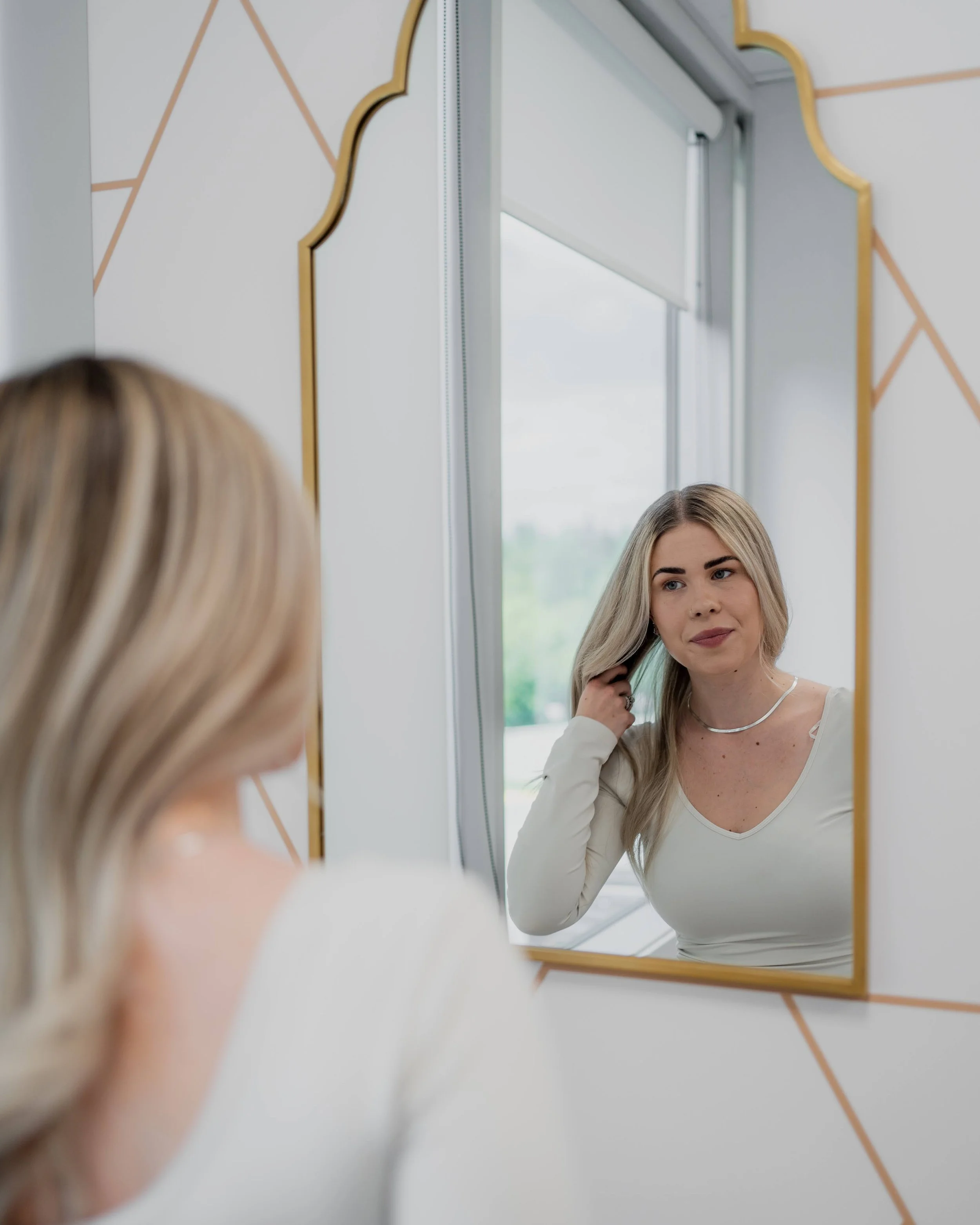
When perimenopause came on the scene, we think a lot of women finally had a word to label what they were truly experiencing.
It isn’t quite menopause, yet, but things are definitely starting to shift. Maybe it’s your cycle, your mood, your symptoms, or it’s your skin. You can’t deny that something in your body is changing.
And, your skin may be the one thing that’s letting everyone else in on your secret.
If your skin has felt noticeably different over the past year or two (drier than it used to be, less firm, slower to heal, more prone to flushing or breakouts), and you are somewhere in your late 30s to late 40s, there is a very good chance we know what’s involved. Not your skincare routine. Not your sleep, though that matters too.
Your hormones.
So, what’s really going on?
Perimenopause is the transitional period leading up to menopause, and it can begin as early as the mid-30s for some women, though the mid-to-late 40s is more typical. It is a prolonged hormonal shift - fun! It can often last four to ten years, but its effects on skin can be significant, progressive, and frequently misunderstood.
What Is Actually Happening to Your Skin
Estrogen is one of the most important hormones for skin health. It supports collagen production, maintains skin thickness and hydration, regulates sebaceous gland activity, and plays a role in wound healing and inflammation response. As estrogen levels begin to fluctuate, and eventually decline during perimenopause, every one of those functions is affected.
The research on this is clear and somewhat sobering: estrogen decline in perimenopause can reduce skin collagen by up to 30% in the first five years. That is not a gradual, barely-perceptible change - that’s fast. For many women, it shows up as a noticeable shift in skin density, elasticity, and texture over a relatively short window.
Other changes that accompany the hormonal shift include:
Increased skin dryness and sensitivity as the skin barrier becomes less effective
Loss of facial volume as collagen and fat compartments diminish together
Increased skin laxity, particularly around the jaw, cheeks, and neck
Adult acne or congestion driven by the increase in androgen activity as estrogen drops
Changes in pigmentation and a tendency toward uneven skin tone
Slower cellular turnover, leading to a duller, less luminous complexion
Wow. There’s a lot happening under the hood there. Thank you hormones!
Why Standard Skincare Often Falls Short
The women who we see at Hebe in their 40s have tried it all…. Retinols, vitamin C, expensive serums, multiple peels at the spa. And, they’re not doing anything wrong. They’re addressing the skin from the outside, in - a topical solution to a structural and physiological problem. When collagen loss is driven by hormonal change happening at a cellular level, the surface interventions that worked in your 30s have a diminishing return.
We aren’t diminishing good skincare. A well-constructed routine matters and should absolutely continue. But, it’s more important to understand what skincare can, and cannot, do. It’s also a time to recognize that what you’re doing is no longer working, and what you can do that’s more appropriate.
What Actually Works During This Window
Because the core issue of perimenopause is collagen loss, treatments that actively stimulate new collagen production address the problem at its source. Sculptra is particularly well suited to this window. Its mechanism of triggering the body's own collagen synthesis works with the biology rather than against it. A course of Sculptra during perimenopause can help offset the structural loss that would otherwise accumulate over several years.
Laser treatments serve two functions that are directly relevant to perimenopausal skin. They address surface-level changes, pigmentation, texture, dullness, that result from slower cellular turnover. And, certain laser protocols stimulate dermal collagen remodeling, improving skin density and quality from within. The Elite iQ and PicoSure Pro lasers available at Hebe are both fantastic for perimenopausal skin concerns, with treatment plans tailored to skin type and specific goals.
Radiofrequency microneedling delivers controlled heat energy deep into the dermis, triggering a robust collagen and elastin remodeling response. For perimenopausal women experiencing skin laxity, particularly around the jaw, lower face, and neck, RF microneedling addresses the tightening concern that no topical products or surface-level treatments can reach.
Strategic use of dermal fillers and biostimulators can address the volume changes that accelerate during perimenopause. Rather than treating lines as the main concern, an experienced injector will assess fat compartment loss, structural support and make recommendations that restore the underlying architecture. This gives you a more natural look, because they are addressing the actual cause of the change.
Timing is of the Essence, and Advantage
One of the most important things to understand about perimenopausal skin is that the earlier you intervene, the better. Here's the thing about collagen: it's much easier to protect what you still have than to try to rebuild what's already gone. Starting collagen-stimulating treatments in your early-to-mid 40s puts you on a completely different trajectory than waiting until your late 40s or 50s. This head start makes a real difference.
But, don’t panic - it’s never too late to start! Urgency isn’t what we are trying to scare you into. We want you to fully understand that this particular window has real biological significance. And, we have some exceptional treatments available that you can start right now.
Where to Start
If you are experiencing skin changes that feel a little off from your normal aging, and you suspect shifting hormones may be the culprit, a consultation at Hebe is a good first step. We’ll assess your skin, and get you a treatment plan that is perimenopause appropriate. We’re here to help you through this transition with a strategy that isn’t a generic anti-aging plan, but one built around what your skin, and hormones, are actually going through.
Book at hebebeautybar.ca.
